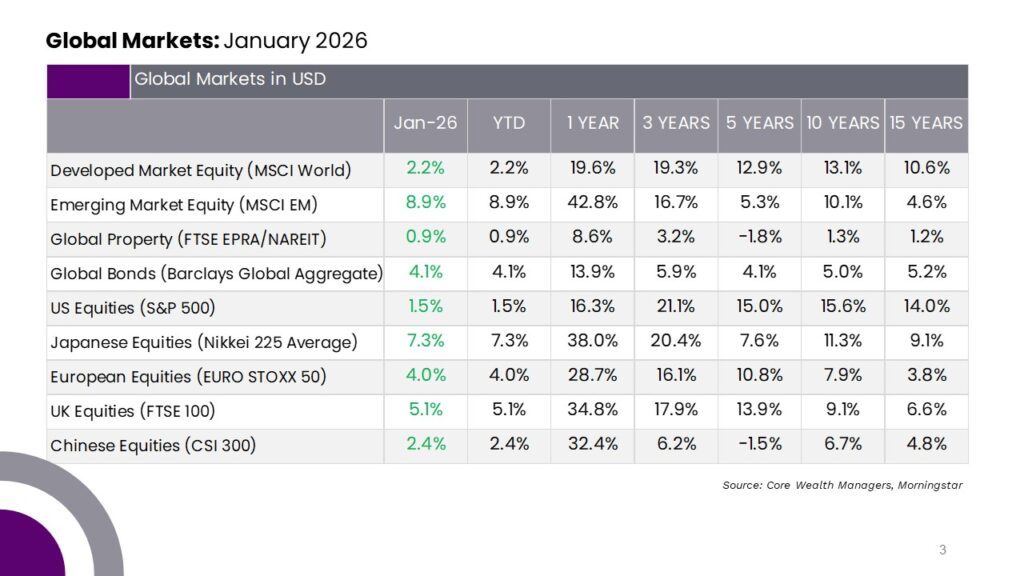
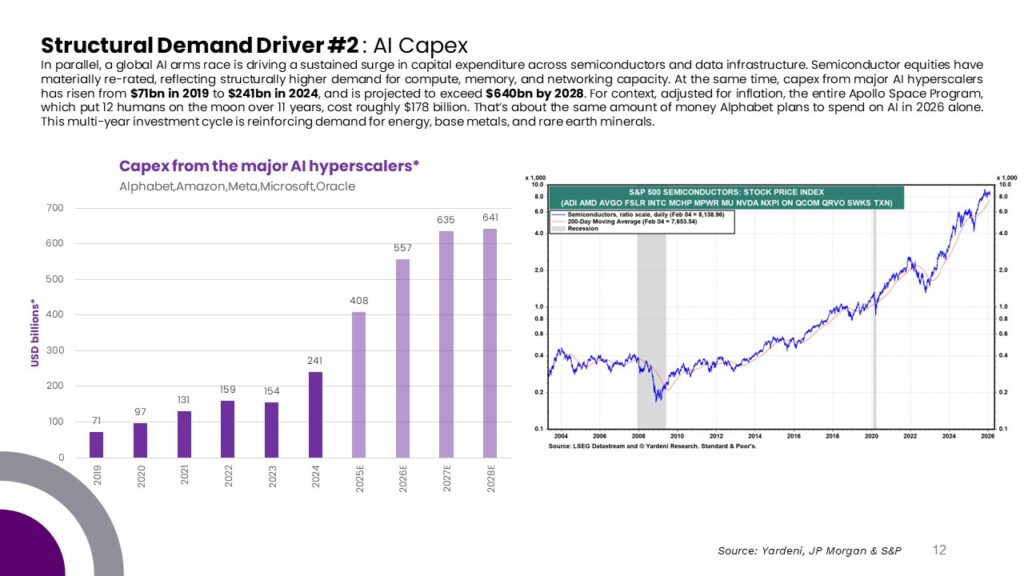
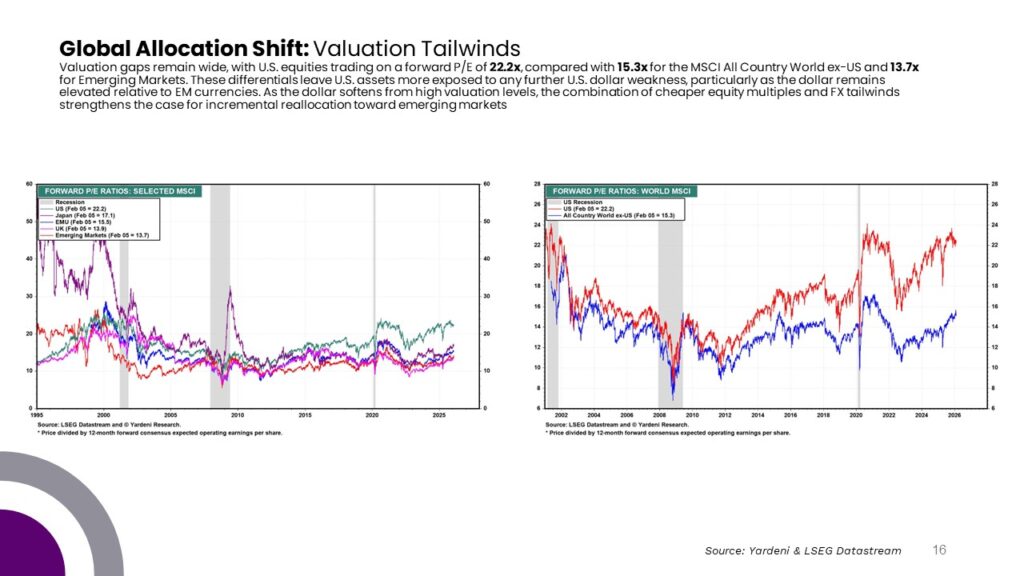
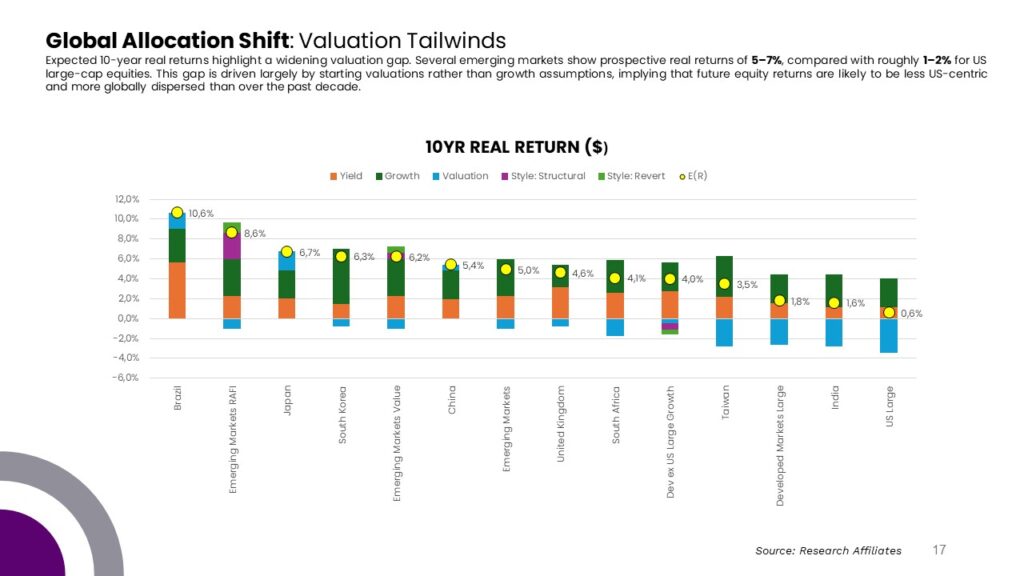
Global equity markets began 2026 on a positive footing, with the MSCI World Index rising +2.2% in January, although returns masked a pronounced rotation in market leadership. Value stocks significantly outperformed growth, with the MSCI World Value Index gaining +4.7% MoM while the MSCI World Growth Index declined –0.3% MoM. Earnings season contributed to volatility among US mega-cap technology stocks, as investors reassessed the scale and near-term returns of accelerating AI investment. Microsoft declined –11% MoM following underwhelming cloud growth alongside record AI-related capital expenditure, while Netflix fell –11% MoM after issuing disappointing guidance and raising concerns around subscriber growth. Apple’s shares eased –5% MoM despite reporting record sales, reflecting concerns over rising component costs. In contrast, Meta outperformed, with its share price rising +9% MoM after delivering record revenue and issuing first-quarter guidance that materially exceeded expectations, highlighting the increasingly selective nature of market leadership.
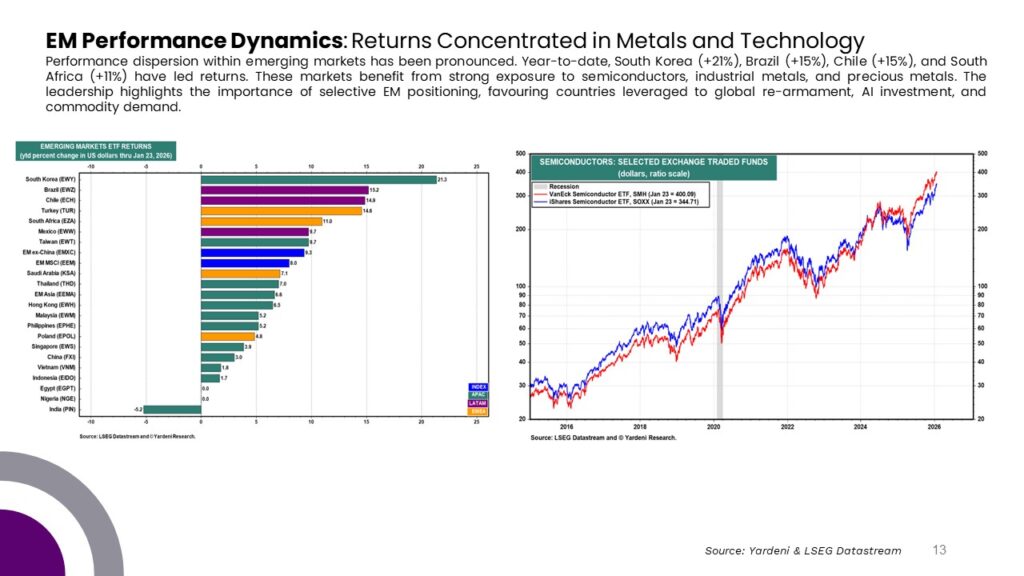
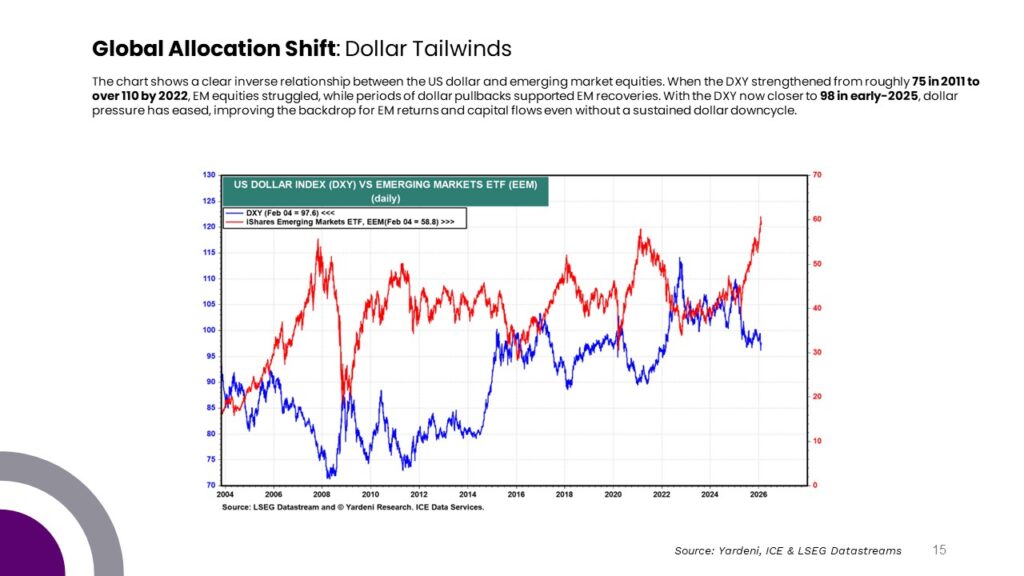
Energy stocks were the standout global performers in January, with the S&P 500 energy sector rising +14% MoM, supported by a +16% MoM increase in the Brent crude oil price to above +US$70/bbl amid heightened geopolitical tensions in Iran and the broader Middle East. Emerging market equities significantly outperformed developed markets, with the MSCI Emerging Markets Index gaining +8.9% MoM, driven primarily by strong performance from semiconductor stocks, which rose +20% MoM, and by miners, which gained +12% MoM and contributed approximately +1% to overall index performance. In fixed income markets, volatility increased despite the US Federal Reserve holding rates steady, as a global bond sell-off pushed US 10-year Treasury yields higher by +0.15%. At the same time, geopolitical tensions between the US and Europe weighed on the US dollar, with the US Dollar Index falling –1.3% MoM to its lowest level in nearly four years.
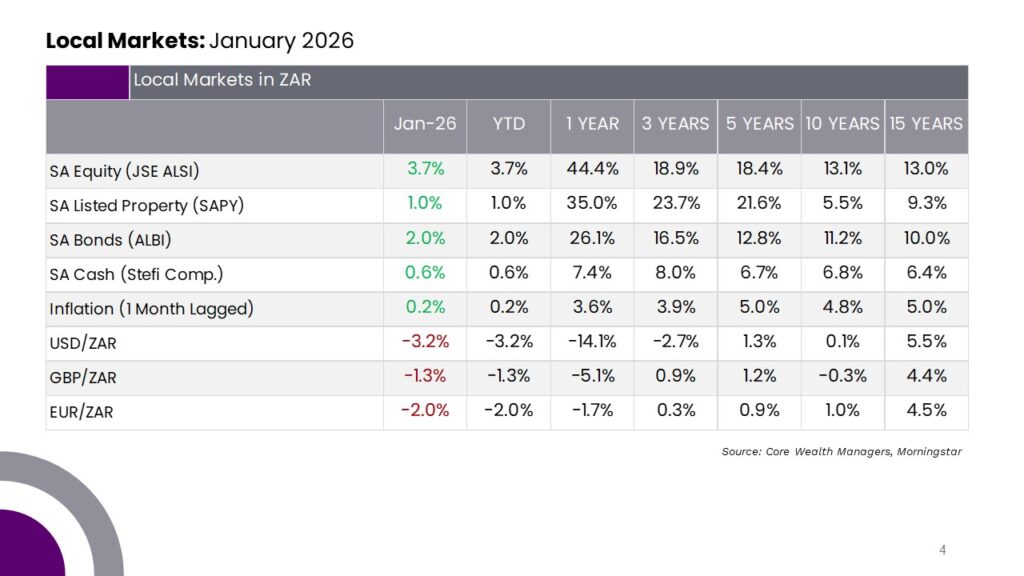
The JSE extended its strong run into January, with the FTSE/JSE Capped All Share Index rising +3.7% MoM, building on gains of approximately +70% over the past two years. Performance was once again dominated by precious metal miners, which contributed +3.5% to the market’s January gains. Gold and platinum prices increased +13% MoM and +7% MoM, respectively, driving gains of +12% MoM in gold mining shares and +15% MoM in platinum miners. Financial stocks also contributed positively, with Ninety One rising +17% MoM, while Investec gained +8% MoM, Absa +6% MoM, and Capitec +5% MoM. However, gains were partially offset by a sharp sell-off on 30 January, when gold prices fell –9% and platinum prices declined –17%, triggering a –4% drop in the broader market. Despite this volatility, The rand strengthened by −3.2% MoM move in USD/ZAR, ending at R16.15/US$1 , while South Africa’s 10-year government bond yield declined –0.15% to +8.05%, its lowest level in almost a decade.